How Top Retail Managers Turn KPIs into Daily Coaching Habits

How to Increase Sales in Retail Stores Without Discounting
May 15, 2026
Retail performance is often blamed on footfall, pricing, staffing, or product mix. Those factors matter. But across multi-location retailers, the more uncomfortable truth is that many stores underperform because execution varies too much from one manager, team, and shift to another.
The best retail managers do not simply report performance. They turn KPIs into daily behaviours — and reinforce those behaviours until they become daily coaching habits.
That is often the difference between a store that consistently performs and one that occasionally gets it right. Not strategy alone. Not dashboards alone. Not training alone. But execution, reinforced consistently through frontline management.
For retailers trying to improve retail sales performance, store manager coaching is not a soft management skill. It is one of the most practical mechanisms for turning business priorities into action on the shop floor.
The challenge is not identifying what good managers do. Most retail leaders can recognise a strong store manager when they see one.
The harder question is this:
How do you make that manager’s playbook repeatable across every location?
Great retail coaching starts with execution, not training
Traditional retail training has long followed a familiar pattern: onboarding sessions, product modules, compliance courses, occasional workshops, and periodic refreshers.
All of these have a role. But they are not enough.
Retail is too dynamic for training to remain an event. Promotions change. stock shifts. Customer objections vary. New employees join. Experienced employees develop bad habits. Store priorities move from conversion to basket size to product attachment to loyalty sign-ups, often within the same quarter.
Training explains what good looks like. Coaching makes it happen repeatedly.
That distinction matters. A training module may teach an employee how to recommend a product. But the behaviour only becomes consistent when a manager observes it, reinforces it, corrects it, recognises it, and connects it back to the store’s KPIs.
This is where top retail managers operate differently. They do not wait for quarterly reviews or formal training cycles. They turn each shift into a feedback loop.
They ask:
What matters this week?
Which behaviour will move it?
Who needs support?
What should be reinforced today?
That is the foundation of effective retail performance management.
What top retail managers do differently
Top-performing retail managers tend to share one trait: they make performance practical.
They do not leave employees with abstract targets. They translate commercial goals into specific frontline actions.
A KPI tells the team what matters. Coaching tells the team what to do next.
They coach in the flow of work
High-performing managers do not save feedback for scheduled reviews. They coach close to the moment of action.
After observing a customer interaction, they may offer a short piece of feedback:
“You built rapport well. Next time, ask one more discovery question before recommending the product.”
That takes less than a minute. But repeated over time, it changes behaviour.
The key is immediacy. Feedback given days later is harder to remember and harder to apply. Feedback given in the flow of work allows the employee to try again on the next customer.
This also changes the culture of feedback. When coaching is frequent and specific, it becomes part of the operating rhythm rather than a sign that something has gone wrong.
The best managers make coaching normal.
They translate KPIs into specific behaviours
Average managers discuss outcomes. Strong managers coach the behaviours that create those outcomes.
There is a large difference between saying:
“Improve your conversion rate.”
and saying:
“Ask one open-ended question before showing the customer a product.”
The first is a target. The second is an action.
Retail KPIs are only useful if employees understand the behaviours behind them. Conversion rate, basket size, attachment rate, loyalty sign-ups, customer reviews, and product recommendations all depend on small actions repeated consistently.
For example:
A low conversion rate may point to weak discovery questions.
A low basket size may point to missed cross-selling opportunities.
Low product attachment may suggest employees lack confidence in recommendations.
Poor customer reviews may reflect inconsistent greetings, waiting times, or service recovery.
Low loyalty sign-ups may show that employees are asking too late, too vaguely, or not at all.
Top managers break performance down into coachable behaviours. They do not try to improve everything at once. They pick one behaviour, reinforce it daily, and make progress visible.
That is how performance starts to move.
They use data to decide what to coach next
Retail generates no shortage of data. The problem is that too much of it remains trapped in reports.
A dashboard can show that conversion is down. It cannot, by itself, change how employees greet, question, recommend, or close.
Top managers use data differently. They do not treat retail performance dashboards as retrospective reporting tools. They use them to decide where coaching should focus.
For example:
If conversion is falling, the manager may observe customer approach and discovery.
If basket size is below target, the manager may coach product bundling or add-on recommendations.
If one store is outperforming others on a campaign, the area manager may identify the behaviour behind it and spread that practice across the network.
If an employee is improving quickly, the manager may recognise the behaviour publicly so others repeat it.
This is the real value of retail KPIs. They create focus.
But focus only matters if it leads to action.
They reinforce improvement, not just compliance
Many retail environments only respond when something is wrong. A target is missed. A standard slips. A customer complains. A store falls behind.
Top managers do the opposite. They reinforce progress before it becomes invisible.
They notice when an employee improves their greeting.
They recognise when a team increases recommendations.
They celebrate when a store closes the gap to target.
They use small wins to build confidence and momentum.
This is not about false positivity. It is about making the desired behaviour more likely to happen again.
What gets reinforced gets repeated.
That principle is central to frontline performance. Retail employees are busy, distracted, and often under pressure. If the only feedback they receive is corrective, coaching becomes something to avoid. If improvement is recognised consistently, coaching becomes part of growth.
Recognition, incentives, nudges, and manager follow-up all play a role here. Not as separate engagement initiatives, but as reinforcement mechanisms.
They spread best practices beyond one strong manager
In many retail businesses, the best ideas remain local.
One store finds a better way to open sales conversations. Another improves product recommendations. Another builds a strong morning huddle. Another manager develops a simple coaching habit that lifts conversion.
But unless the organisation has a system for capturing and spreading those behaviours, top-performing stores stay exceptions.
This is one of the most common execution gaps in multi-location retail.
The business may have the same brand, same products, same pricing, and same targets. But performance varies because manager routines vary.
Top retail managers create local excellence. Top retail organisations make that excellence repeatable.
That requires more than a playbook. It requires an operating rhythm.
Why coaching fails to scale across retail networks
Most retailers do not struggle because they lack ambition. They struggle because daily execution is difficult to standardise.
At head office, the priorities are clear. Improve conversion. Increase basket size. Push a new product line. Improve customer experience. Strengthen loyalty sign-ups. Reduce early attrition. Raise audit scores.
On the shop floor, those priorities compete with queues, stock issues, rota gaps, customer complaints, new starters, operational tasks, and the realities of busy trading periods.
The result is inconsistency.
Some managers know exactly what to coach. Others focus only on the number. Some teams receive daily feedback. Others hear about performance once a week. Some stores turn KPIs into action. Others simply review reports after the fact.
Common barriers include:
Managers are overloaded.
Store managers are responsible for sales, staffing, operations, customer experience, compliance, communication, and team morale. Coaching often becomes the thing everyone agrees is important but no one has time to structure.
Dashboards show what happened, not what to do next.
Retail performance dashboards are useful, but many stop at visibility. They show the gap without translating it into the behaviour that needs attention.
Training does not always stick.
Employees may complete onboarding and product training, but knowledge fades unless it is reinforced in real situations.
Manager capability varies.
Some managers naturally coach well. Others need prompts, structure, and confidence.
Incentives reward outcomes without shaping behaviours.
Sales competitions and bonuses can motivate teams, but they work best when employees understand the behaviours that will help them win fairly and perform consistently.
This is why coaching needs to move from individual manager habit to organisational system.
The operating rhythm behind scalable coaching
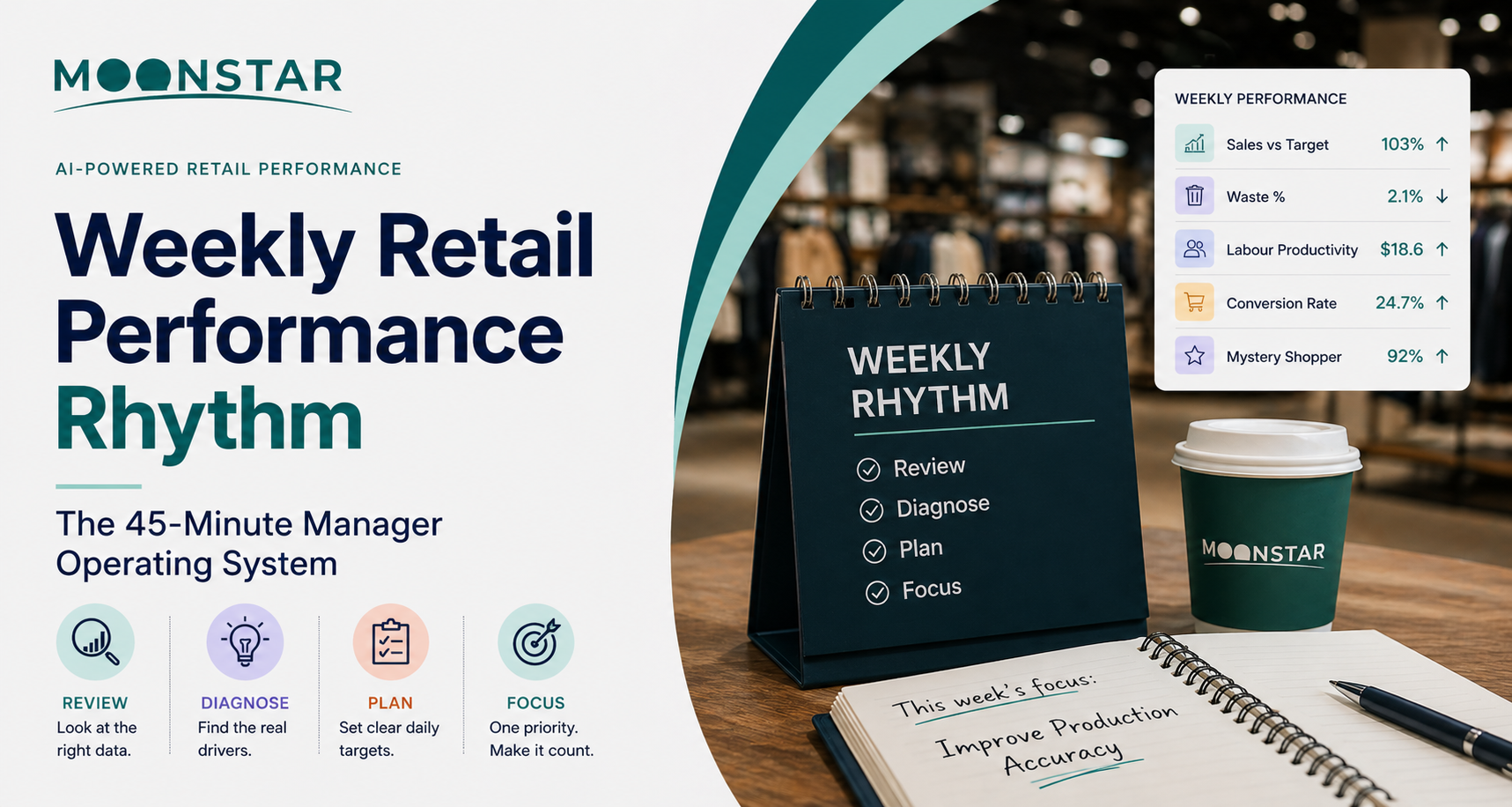
Scalable coaching depends on a simple performance loop:
Focus → Behaviour → Reinforcement → Results
This is the operating logic behind effective frontline execution.
First, the organisation must create focus. Not twenty priorities. A few clear KPIs that matter now.
Second, managers must translate those KPIs into behaviours. If the goal is to improve conversion, what should employees do differently with the next customer? If the goal is to increase basket size, what recommendation behaviour should be practised? If the goal is to improve customer reviews, what service habit needs reinforcement?
Third, the behaviour must be reinforced. That can happen through manager coaching, micro-learning, nudges, recognition, incentives, peer examples, and team huddles.
Finally, results must be visible. Teams need to see whether the behaviour is working. Managers need to know where to continue, where to intervene, and where best practices are emerging.
This loop is what turns retail performance management from retrospective reporting into daily execution.
Without it, KPIs remain numbers.
With it, KPIs become habits.
How technology helps managers reinforce the right behaviours
Technology does not replace store managers. In retail, that is the wrong ambition.
The role of technology is to help managers focus, act, and reinforce more consistently.
A useful frontline performance system should help managers answer practical questions:
Which KPI matters most this week?
Which store, team, or employee needs support?
What behaviour should be coached?
What learning or nudge would reinforce it?
Which teams are improving?
Which best practices should be shared?
Where is execution inconsistent?
This is very different from simply adding another dashboard.
Most retailers already have data. What they often lack is an execution layer that connects data to daily behaviour.
That execution layer should bring together KPI visibility, coaching prompts, micro-learning, incentives, recognition, communication, and performance tracking. Not as disconnected initiatives, but as one operating rhythm for the frontline.
That is how strong manager habits become scalable.
How Moonstar turns store manager coaching into a repeatable performance system
In many retail organisations, coaching quality depends too heavily on the individual manager.
One store has a manager who turns every KPI into action. Another has the same dashboard but no clear rhythm for follow-up. One team receives daily reinforcement. Another only hears about performance when results are missed.
Moonstar helps close that gap.
Moonstar is a frontline performance platform for multi-location businesses. It helps retailers turn KPIs into daily behaviours through live KPI visibility, manager coaching, micro-learning, incentives, nudges, recognition, communication, pulse checks, and performance dashboards.
The aim is not more reporting.
The aim is better daily action.
With Moonstar, retailers can connect the pieces that usually sit apart:
- retail KPIs and store performance dashboards
- manager coaching and follow-up
- micro-learning in the flow of work
- nudges that reinforce priority behaviours
- recognition and incentives that motivate action
- communication that keeps teams aligned
- performance visibility across stores, teams, and employees
At the core is PerformIQ, Moonstar’s operating model for frontline performance:
Focus → Behaviour → Reinforcement → Results
A retailer may start with a KPI such as conversion, product recommendations, basket size, audit score, or customer experience. Moonstar helps translate that focus into the behaviours managers should coach and teams should repeat.
For example:
If conversion is below target, managers can focus coaching on customer approach and discovery questions.
If product recommendations are weak, teams can receive nudges, micro-learning, and recognition tied to recommendation behaviours.
If one store is outperforming, best practices can be made visible and shared across the network.
If employees are improving, progress can be recognised before momentum fades.
This is where coaching becomes more than a manager skill. It becomes part of the operating system of the business.
Moonstar has already helped frontline teams connect performance visibility with action. Across client examples, Moonstar has supported outcomes such as a 14% increase in sales, a 65% increase in product recommendations, and a 75% increase in stores systematically hitting sales targets.
These results matter because they point to a larger principle: performance improves when the right behaviours are made visible, coached, reinforced, and repeated.
Top-performing stores should not remain exceptions.
They should become the model.
The takeaway: coaching is how execution becomes repeatable
The practices of top retail managers are not mysterious. They are practical, observable, and repeatable.
They coach in the flow of work.
They turn KPIs into specific behaviours.
They use data to focus attention.
They reinforce progress.
They spread what works.
The harder task is making those habits consistent across every store.
That is where many retailers fall short. They review performance but do not always change execution. They train employees but do not always reinforce behaviour. They set targets but do not always show teams what to do differently tomorrow.
Daily coaching closes that gap.
For retailers trying to improve retail sales performance, strengthen frontline employee engagement, and build more consistent store execution, the lesson is clear: coaching is not an occasional management activity. It is the mechanism that turns strategy into behaviour.
And in multi-location retail, behaviour is where performance is won.
FAQ
What is store manager coaching in retail?
Store manager coaching is the daily practice of helping frontline employees improve the specific behaviours that drive retail KPIs. These behaviours may include greeting customers, asking better discovery questions, recommending relevant products, increasing basket size, improving loyalty sign-ups, or strengthening customer experience.
How does coaching improve retail sales performance?
Coaching improves retail sales performance by turning targets into observable actions. Instead of simply telling employees to improve conversion or sell more, managers coach the behaviours that influence those outcomes, such as better customer approach, stronger product knowledge, relevant recommendations, and confident closing.
Why does retail training often fail to improve performance?
Retail training often fails when it is treated as a one-off event. Employees may understand the content during training, but behaviour changes only when learning is reinforced through manager coaching, nudges, recognition, incentives, and repeated practice in the flow of work.
How can retailers scale coaching across multiple stores?
Retailers can scale coaching by defining priority KPIs, linking each KPI to specific frontline behaviours, giving managers a simple weekly coaching rhythm, using dashboards to identify performance gaps, and reinforcing improvement through micro-learning, nudges, recognition, and incentives.
What retail KPIs should managers coach around?
Common retail KPIs include conversion rate, average transaction value, basket size, units per transaction, product attachment, loyalty sign-ups, customer satisfaction, Google reviews, operational audit scores, and employee performance metrics. The best KPI to coach depends on the store’s current performance priority.
How does Moonstar support retail manager coaching?
Moonstar helps retailers turn KPIs into daily behaviours through live KPI visibility, manager coaching, micro-learning, nudges, incentives, recognition, communication, pulse checks, and performance dashboards. It helps multi-location businesses make coaching more consistent across every store.
Last updated on 25.05.2026