Weekly Retail Performance Rhythm: The 45-Minute Manager Operating System
Sales Gamification for Retail Teams: What Works and What Backfires
April 24, 2026
How to Increase Sales in Retail Stores Without Discounting
May 15, 2026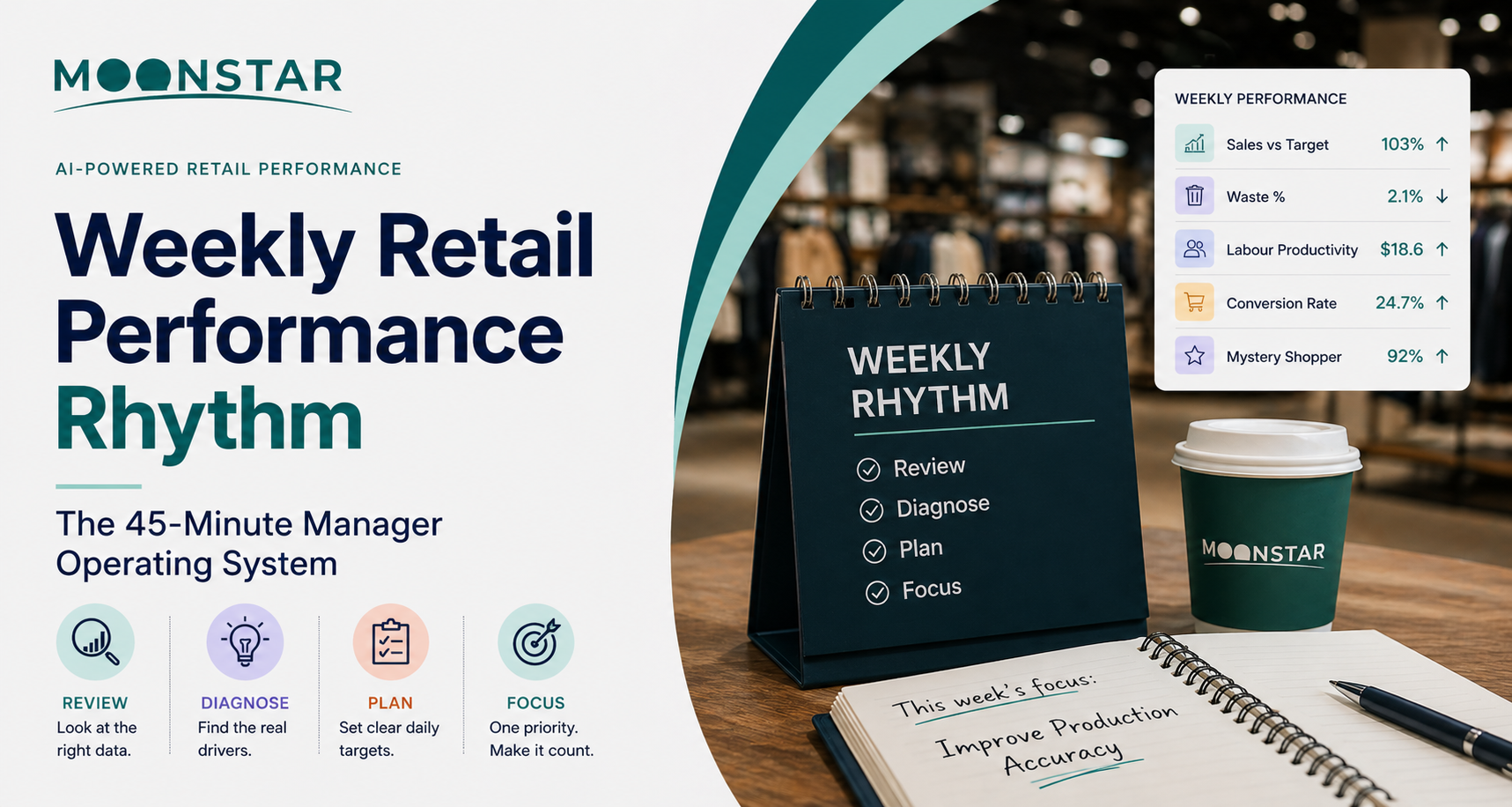
Retail is often described as a scale business. Standardise the format, refine the offer, replicate the playbook and growth should follow. Yet anyone who has overseen a multi-site network knows the uncomfortable truth: two shops operating under identical brand standards can produce materially different results.
The divergence doesn’t lie in strategy. It lies in execution.
Performance in retail is shaped less by what the quarterly plan aims for and more by what a manager decides on a rainy Tuesday at 11:30am, when sales are tracking below target and the lunch rush is already forming. Understanding retail performance is crucial for success.
The difference between strong and average stores is rhythm. The best managers operate to a disciplined weekly cadence that converts lagging metrics into leading action.
What follows is a case for a simple but rigorous structure: a 45-minute weekly operating system that transforms retail performance management from retrospective commentary into forward control, focusing on enhancing overall retail performance.
The Problem With Lagging Control in Retail Performance Management
Retail organisations track plenty of data. Sales, waste, labour productivity, conversion, average transaction value, traffic, mystery shopper scores—most networks track a dense cluster of KPIs. Targets are often set quarterly, cascaded to monthly and ideally weekly levels. These systems create accountability.
They also create distance.
Sales confirm what customers did yesterday. Waste reveals what was overproduced. Labour metrics expose mismatches that have already cost margin. By the time numbers appear in a weekly report, the behaviours that produced them are embedded.
The strongest retail managers understand that store performance improvement does not happen at the moment of review. It happens at the moment of decision—when production is set, employee schedules are written, and service standards are reinforced.
Yet the decisive period frequently comes immediately after formal training ends. The first four to six weeks of independent management determine whether disciplined retail management habits form or reactive firefighting takes hold. Without a structured weekly operating rhythm, performance volatility becomes the norm.
The 45-Minute Weekly Retail Performance Operating System
Improving retail store performance does not require a new hierarchy or a complex transformation plan. It requires disciplined cadence. A focused 45-minute weekly review can anchor execution if it concentrates on the right questions.
At its core, the weekly retail performance rhythm revolves around four moves:
- 15 mins Review with precision. Examine weekly sales against target, waste percentage, labour productivity, conversion rate and average transaction value. Look for patterns, not excuses. Which days underperformed? Did peak periods convert as expected? Where did margin erode?
- 15 mins Diagnose specifically. If performance slipped, define the cause in operational terms. Elevated waste may indicate flawed production forecasting or over-ordering. Weak conversion may reflect poor deployment of labour during peak traffic. Declining mystery shopper scores may signal inconsistent service standards or lapses in cleanliness. A credible retail action plan is concrete, not aspirational. A store visit checklist completed on the floor gives that diagnosis evidence instead of guesswork.
- 10 mins Translate insight into daily clarity. Weekly analysis must cascade into daily targets that teams can act upon. Store managers should know their daily sales expectation, acceptable waste range and labour benchmark. Teams perform better when daily retail KPIs are visible for everyone and discussed openly.
- 5 min Choose a single operational focus. Attempting to improve every KPI simultaneously diffuses attention. Selecting one performance priority for the coming week—production accuracy, upselling discipline, staffing optimisation or customer service intensity—creates coherence and measurable progress.
Tacit knowledge—how to read a shop at a glance, when to flex labour, how to correct standards without damaging morale—travels best through structured mentoring. However, as retail networks scale, maintaining coaching quality and consistency becomes increasingly difficult.
The discipline lies not in complexity but in repetition. Forty five minutes, every week, without fail. Over time, this retail manager operating system reduces variance and strengthens forecasting accuracy, labour productivity and margin protection.
Intervention, Incentives and AI in Retail Store Performance
In high-performing retail organisations, this weekly cadence is reinforced structurally. New or underperforming managers receive more frequent oversight, while experienced managers with stable results operate with greater autonomy. Incentives often align individual bonuses with area-level performance (rather than just store level), thus encouraging peer mentoring and shared accountability.
One of the most effective store manager development tools remains pairing new managers with experienced peers.
Tacit knowledge—how to read a shop at a glance, when to flex labour, how to correct standards without damaging morale—travels best through structured mentoring. However, as retail networks scale, maintaining coaching quality and consistency becomes increasingly difficult.
This is where AI in retail operations can play a meaningful supporting role.
An AI-powered interactive coach cannot replace human leadership. It can, however, strengthen decision-making discipline. A manager noticing that sales are trending below target midday could explore data-driven guidance: how similar days have evolved historically, how weather has influenced traffic patterns, what production adjustments imply for waste, and how labour changes might affect conversion.
More importantly, AI can reinforce structured reflection at week’s end:
- What changed this week?
- Which KPI moved most significantly?
- What specific action will you take next week?
- Who on the team requires targeted coaching?
Used well, AI does not automate retail management. It institutionalises the habits of strong managers and supports consistent retail performance management across locations, supporting area and store managers.
This is where Moonstar comes in. Built specifically for multi-site retail environments, Moonstar translates the principles of disciplined execution into a scalable, repeatable system through its PerformIQ framework. Rather than adding another layer of reporting, it embeds a consistent weekly rhythm directly into the way managers operate—guiding them from data review to diagnosis to clear, prioritised action.
By combining structured performance cadences with AI-powered coaching, Moonstar helps managers move beyond hindsight and into real-time decision support: surfacing patterns across stores, highlighting the operational drivers behind KPI shifts and prompting the right interventions at the right moment. Crucially, it standardises what great looks like without removing autonomy—ensuring that whether a manager is in their second week or their fifth year, they are supported by the same high-quality performance logic. In doing so, Moonstar reduces executional variance across locations, strengthens managerial capability at scale and reinforces the very cadence that underpins consistent retail excellence.
Retail Excellence Is a Cadence, Not a Campaign
Retail leaders often search for advantage in new formats, pricing strategies or marketing campaigns. Yet within established store networks, performance dispersion is more often driven by executional variance than strategic deficiency.
The difference between an average and an exceptional store is rarely dramatic. It is cumulative. A small overproduction decision here, a missed coaching moment there, a poorly aligned staffing during peak hours—each compounds quietly.
A disciplined weekly retail performance rhythm interrupts that drift. It converts lagging retail KPIs into leading behaviours, aligns daily store execution with quarterly targets and embeds accountability without bureaucracy.
A good store manager knows their targets. A strong store manager understands their data. But a consistently high-performing retail leader operates to a rhythm that turns insight into action, week after week.
In retail, excellence is not an event. It is a cadence.
FAQ: Retail Performance Management & Store Execution
What is a retail manager operating system?
A retail manager operating system is a structured weekly rhythm that helps store managers review performance data, diagnose issues, set daily targets and define a clear operational focus. It transforms retail performance management from reactive reporting into proactive execution.
How can retail stores improve performance without increasing costs?
Improvement often comes from better operational discipline rather than additional spend. Optimising production planning reduces waste, aligning labour to traffic improves productivity, and strengthening conversion increases sales without raising fixed costs.
What are the most important retail KPIs to review weekly?
Core retail KPIs typically include sales versus target, waste percentage, labour productivity (hours versus transactions), conversion rate, average transaction value and customer experience indicators such as mystery shopper scores.
How often should store managers review performance data?
Store managers should review key metrics daily at team level and conduct a structured weekly performance review. Area managers may adjust oversight frequency depending on store stability and manager experience.
Can AI genuinely improve retail store performance?
AI can enhance retail decision-making by identifying patterns, simulating operational adjustments and prompting structured reflection. While it cannot replace leadership or culture, it can improve consistency and speed of managerial judgement, particularly for new store managers.
Last updated on 08.10.2026