Sales Gamification for Retail Teams: What Works and What Backfires

Retail Performance Dashboard: The 10 KPIs Every Store Manager Should Track
March 12, 2026
Weekly Retail Performance Rhythm: The 45-Minute Manager Operating System
April 28, 2026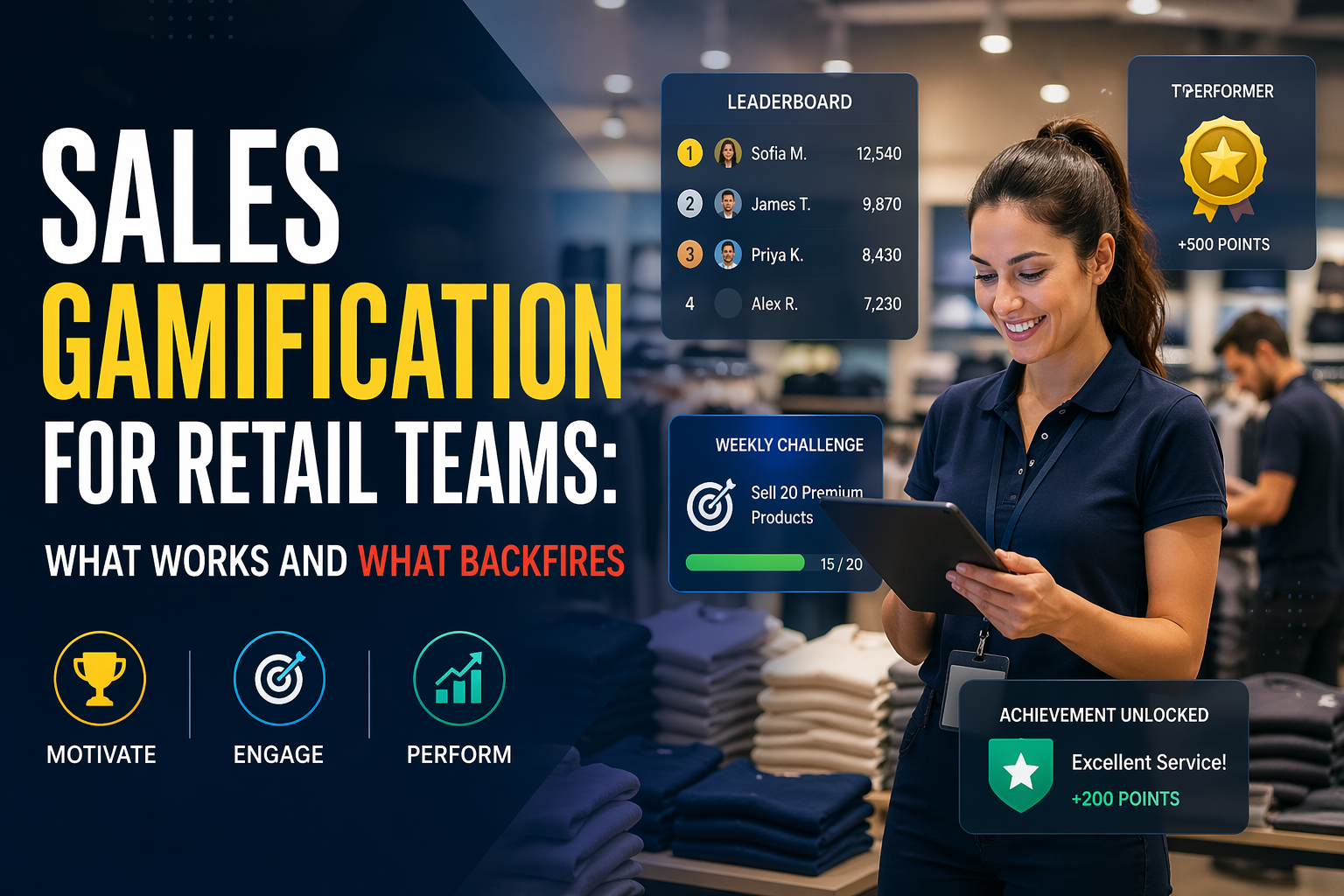
Retail has always been about of performance. Every interaction, from a well-timed greeting to a carefully framed upsell, carries measurable consequences. In recent years, sales gamification has emerged as a popular strategy to sharpen that performance—promising higher engagement, stronger motivation, and ultimately, better revenue outcomes. Yet, as with many management trends, its effectiveness depends less on its adoption and more on its execution.
Done well, sales gamification can transform routine transactions into purposeful activity. Done poorly, it risks fostering unhealthy competition, short-termism, and disengagement. For retail leaders navigating increasingly complex customer expectations and workforce dynamics, the question is no longer whether to gamify sales, but how to do so intelligently.
This article explores what works in sales gamification for retail teams—and what consistently backfires.
What Is Sales Gamification in Retail?
Sales gamification refers to the application of game mechanics—points, leaderboards, rewards, challenges—into the sales environment to motivate employee behavior. In retail, this often takes the form of:
- Time-bound sales contests
- Performance leaderboards displayed in-store or digitally
- Badges & Incentives tied to product-specific goals
- Team-based challenges across locations
At its core, sales gamification is not about games. It is about behavioral design: structuring incentives and feedback loops in ways that influence how employees act on the shop floor.
Why Retailers Are Turning to Gamification
The appeal of sales gamification is rooted in three structural realities of retail:
1. High employee turnover
Retail teams are often transient. Gamification provides a quick way to focusonboard and engage employees without lengthy training cycles.
2. Measurable performance metrics
Unlike many industries, retail offers clear, immediate data—units sold, average transaction value, conversion rates—making it ideal for gamified systems.
3. Repetitive workflows
Selling similar products day after day can lead to disengagement. Gamification introduces variation and a sense of progression.
When aligned correctly, these factors make retail fertile ground for gamification strategies. But alignment is precisely where many initiatives falter.
The Six Strategies That Deliver Results in Sales Gamification
1. Clear, Attainable Objectives
The most effective sales gamification systems begin with clarity. Employees must understand exactly what is being measured and why it matters.
Successful programs typically:
- Focus on a small number of key metrics – maximum five
- Align gamified goals with broader business objectives
- Offer transparency in how performance is calculated
For example, incentivising “units sold” alone may drive volume but undermine profitability. A more refined metric—such as margin contribution or bundled sales—ensures that gamification supports sustainable outcomes.
One great example of clear, fun gamification that drives real results is Luxottica – store clusters with clearly defined targets and fun competitions (Holiday Jingle Bingo), focusing on more than just units sold.
Clarity reduces friction. Ambiguity, by contrast, breeds mistrust.
2. Frequent, Real-Time Feedback
Retail operates in real time, and so should gamification. Delayed feedback diminishes its motivational impact.
High-performing systems provide:
- Live leaderboards
- Instant notifications on achievements
- Daily or even hourly progress updates
This immediacy creates a feedback loop that reinforces desired behavior. Employees can adjust their approach within a single shift rather than waiting for end-of-week summaries.
The psychology is straightforward: people are more likely to repeat actions when the reward is immediate and visible.
3. Recognition Over Rewards
While financial incentives remain important, recognition often proves more powerful in sustaining engagement.
Effective sales gamification programs:
- Highlight top performers publicly
- Celebrate incremental achievements, not just top rankings
- Incorporate non-monetary rewards such as status or privileges
Recognition taps into intrinsic motivation—pride, belonging, and social validation—rather than relying solely on extrinsic rewards.
A leading European Home&Deco retailer designed challenges around core sales scenarios—like upselling, handling objections, and closing complex deals. Employees earned points for correct actions and timely completions, encouraging repetition and mastery. Top performers were awarded Moonstar badges and nation-wide recognition.
Retailers that overemphasise cash bonuses may find that motivation wanes once the novelty fades or budgets tighten. Recognition, by contrast, scales more sustainably.
4. Balanced Competition
Competition is central to gamification, but its design matters.
Healthy competition:
- Encourages self-improvement rather than zero-sum rivalry
- Includes multiple “ways to win” (e.g., most improved, best customer feedback)
- Avoids concentrating rewards among a small elite (a popular example is teaming up stores in regional clusters)
When only the top performers consistently win, the majority disengage. A well-designed system broadens participation by recognising different forms of success.
Retail leaders should think less about crowning a single winner and more about creating a competitive ecosystem where many employees can succeed.
5. Team-Based Mechanics
Retail is rarely an individual sport. Store performance depends on coordination, not just individual brilliance.
Incorporating team-based elements:
- Strengthens collaboration
- Reduces internal friction
- Aligns incentives across roles
For instance, rewarding an entire store for achieving a conversion target encourages employees to support one another rather than compete destructively.
Hybrid models—combining individual and team rewards—tend to produce the most balanced outcomes.
6. Alignment with Customer Experience
The most overlooked aspect of sales gamification is its impact on customers.
Well-designed systems:
- Reward behaviors that enhance customer satisfaction
- Incorporate qualitative metrics such as reviews or feedback
Retailers must resist the temptation to optimise for short-term sales at the expense of long-term loyalty. Gamification should reinforce the brand experience, not distort it.
What Backfires in Sales Gamification
If the six principles above define success, their absence explains failure. Several recurring pitfalls undermine even well-intentioned gamification efforts.
1. Overemphasis on Leaderboards
Leaderboards are among the most common tools in sales gamification—and one of the most misused.
While they can motivate top performers, they often:
- Discourage those consistently ranked at the bottom
- Create a sense of futility among mid-tier employees
- Foster unhealthy competition
A leaderboard that rarely changes becomes less a motivator and more a reminder of hierarchy.
The solution is not to eliminate leaderboards, but to contextualise them—resetting rankings regularly, segmenting by experience level, or pairing them with other forms of recognition.
2. One-Size-Fits-All Incentives
Retail teams are diverse, encompassing different age groups, motivations, and career stages. A uniform incentive structure rarely resonates with all employees.
What backfires:
- Offering identical rewards regardless of individual preferences
- Ignoring cultural or regional differences across stores
- Assuming financial incentives are universally motivating
Personalisation, even in simple forms, can significantly improve engagement. Allowing employees to choose from a range of rewards often proves more effective than prescribing a single option.
3. Short-Term Thinking
Many sales gamification programs are designed around short bursts—weekly contests, monthly targets—without considering long-term behavior.
This can lead to:
- Gaming the system (e.g., pushing unnecessary products)
- Burnout from constant pressure
- Declining engagement once campaigns end
Sustainable gamification requires continuity. Rather than a series of disconnected campaigns, it should function as an ongoing system that evolves with the business.
4. Ignoring Data Integrity
Gamification relies on accurate data. When employees perceive metrics as unreliable or unfair, trust erodes quickly.
Common issues include:
- Delayed or incorrect sales attribution
- Lack of transparency in calculations
- Inconsistent tracking across channels
In an era of omnichannel retail, ensuring data consistency is increasingly complex—but also essential. Without it, even the most sophisticated gamification system will fail.
5. Encouraging the Wrong Behaviors
Perhaps the most dangerous pitfall is misaligned incentives.
Examples include:
- Rewarding volume over value, leading to discount-heavy sales
- Incentivising add-ons that customers do not need
- Prioritising speed over service quality
Such systems may boost short-term metrics while quietly eroding brand equity.
The principle is simple: employees optimise for what is measured. If the metrics are flawed, the outcomes will be too.
6. Lack of Manager Involvement
Gamification is not a substitute for leadership. When managers disengage, the system loses context and credibility.
What often goes wrong:
- Managers treat gamification as a “set-and-forget” tool
- Lack of coaching to support underperforming employees
- Failure to interpret results beyond raw numbers
The most effective programs integrate gamification into broader management practices, using it as a tool for conversation, not just competition.
A Subtle Shift: From Competition to Engagement
The evolution of sales gamification reflects a broader shift in workplace dynamics. Where early systems emphasised competition, modern approaches focus increasingly on engagement.
This shift recognises that:
- Employees value purpose as well as performance
- Collaboration often drives better outcomes than rivalry
- Sustainable motivation requires more than incentives
Retailers that embrace this perspective are better positioned to design systems that endure.
Conclusion
Sales gamification, when thoughtfully implemented, can be a powerful tool for retail teams. It offers a way to align individual behavior with organisational goals, inject energy into routine tasks, and provide real-time visibility into performance.
Yet its effectiveness is far from guaranteed. Poorly designed systems can distort incentives, alienate employees, and undermine customer experience.
The difference lies in execution. Clear objectives, balanced competition, meaningful recognition, and alignment with long-term goals distinguish successful programs from failed ones.
In the end, sales gamification is not about turning work into a game. It is about understanding human motivation—and designing systems that respect its complexity while at the same time delivering results for the business.
FAQ: Sales Gamification in Retail
What is sales gamification?
Sales gamification is the use of game-like elements—such as points, leaderboards, and rewards—to motivate sales performance and influence employee behavior.
Does sales gamification work in retail?
Yes, when implemented correctly. It can improve engagement, productivity, and alignment with business goals. However, poor design can lead to unintended consequences.
What are the biggest mistakes in sales gamification?
Common mistakes include overreliance on leaderboards, misaligned incentives, lack of data accuracy, and focusing solely on short-term results.
How can retailers measure the success of gamification?
Success should be measured through a combination of sales metrics, employee engagement levels, and customer satisfaction indicators.
Is gamification suitable for all retail teams?
Not necessarily. Its effectiveness depends on team culture, management practices, and how well the system is tailored to employee needs.
Last updated on 24.04.2026