How to Increase Sales in Retail Stores Without Discounting
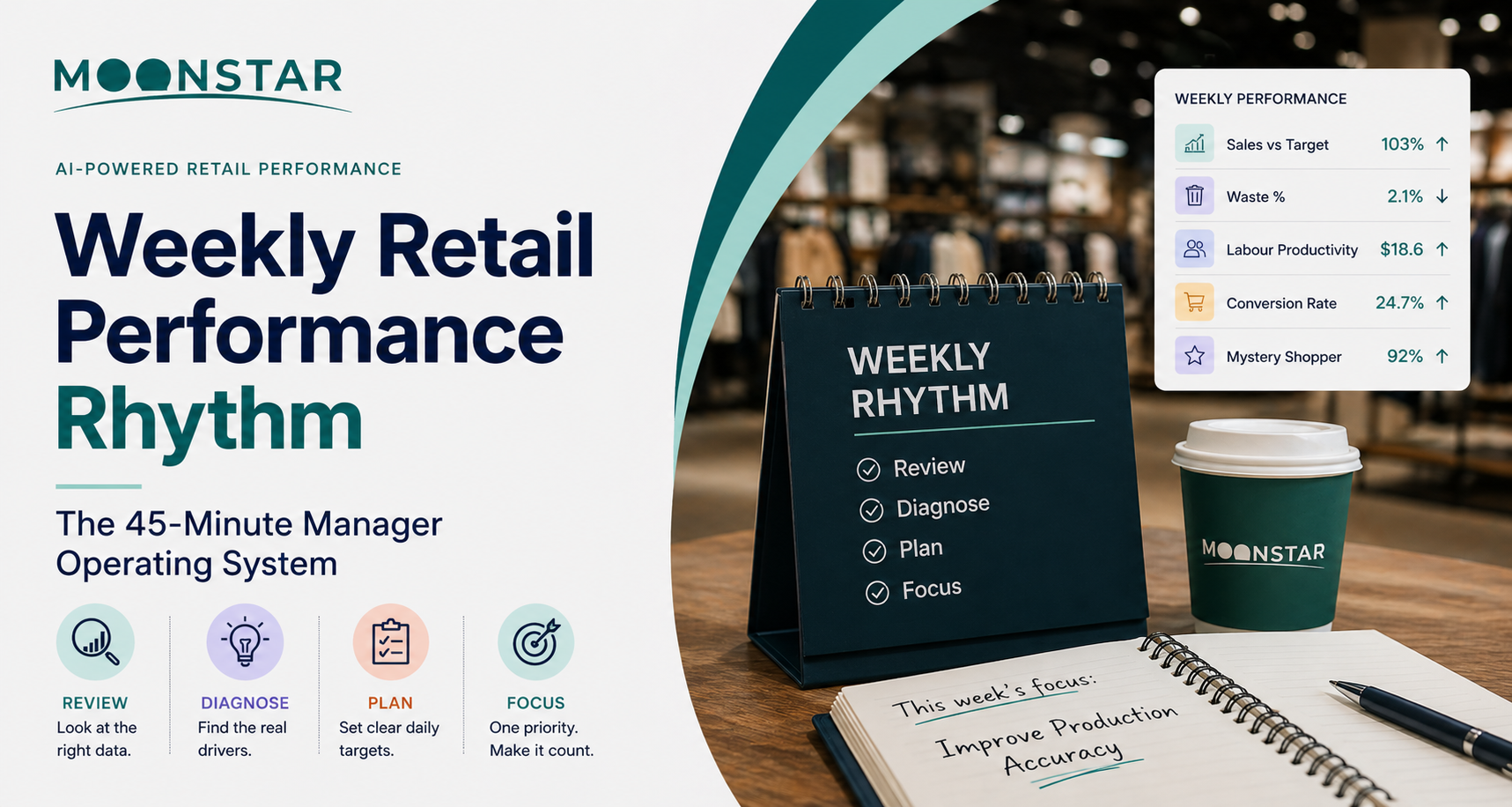
Weekly Retail Performance Rhythm: The 45-Minute Manager Operating System
April 28, 2026
How Top Retail Managers Turn KPIs into Daily Coaching Habits
May 22, 2026
Discounting is the oldest reflex in retail.
When sales soften, footfall weakens or a competitor becomes more aggressive, the temptation is immediate: reduce the price and wait for demand to return. It is simple, visible and easy to explain.
It is also expensive.
The problem with discounting is not that it fails to work. Often, it works too well. It pulls demand forward, trains customers to wait, compresses margins and leaves store teams with the wrong lesson: that price, not performance, is the main lever they can influence.
Over time, a retailer that relies too heavily on discounts may find that it has increased transactions while weakening the economics that make those transactions worthwhile.
The better question is not how to sell more cheaply.
It is how to sell smarter.
To increase sales in retail, the key sits in a handful of controllable behaviours:
- greeting customers promptly;
- diagnosing customer needs;
- recommending relevant products;
- improving conversion;
- increasing basket size;
- attaching services, accessories or complementary products;
- helping employees understand what good performance looks like.
Increasing retail sales without discounting is therefore not a matter of motivational slogans. It is an operating discipline.
It requires clearer metrics, better coaching, sharper execution and a store environment in which frontline employees know what to do, why it matters and how they are progressing.
1. Focus first on conversion, not footfall
Many retailers treat traffic as destiny.
If fewer people enter the store, sales fall. If more people enter, sales rise. There is truth in this, but it is incomplete.
Store teams rarely control the number of people walking past the door. They do, however, influence what happens once a customer is inside.
That is why conversion rate is one of the most important retail sales performance metrics.
A store that receives 1,000 visitors and converts 18% of them is facing a different challenge from a store that receives 500 visitors and converts 35%. Without looking at conversion, managers can easily mistake a traffic problem for a selling problem.
To improve retail store performance, managers should review conversion by:
- day;
- shift;
- location;
- campaign period;
Patterns matter.
If conversion drops during lunch hours, staffing may be misaligned. If weekend traffic is high but conversion is weak, employees may be too busy replenishing shelves to sell. If one store consistently outperforms similar peers, its behaviours should be studied, not merely praised.
The practical question for every store manager is simple:
When a customer enters, what increases the probability that they buy?
The answer may be faster acknowledgement, better product knowledge, stronger questioning, clearer recommendations or a more confident close. None requires a discount. All require attention.
2. Increase basket size through relevance, not pressure
Average transaction value is often misunderstood.
Poorly managed, it becomes a crude instruction to “sell more”. Well managed, it becomes a guide to better customer service.
The aim is not to push unnecessary products. The aim is to help customers complete the purchase they actually came to make.
One leading bakery runs detailed analysis on top sellers, by time of day, and what add-on products clients purchase together. Then, with the help of Moonstar, they push trainings on bundling products that already make sense for the customer depending on time of day and need, as well as incentives to motivate employees to maximize recommendations.
This is where retail upselling techniques matter.
The best upselling does not feel like upselling. It feels like expertise.
Employees should be trained to ask useful questions, identify the customer’s intended outcome and recommend additions that make the original purchase more successful.
There is a difference between aggressive selling and professional selling.
Aggressive selling asks: What else can we make the customer buy?
Professional selling asks: What would make this purchase more useful, complete or satisfying?
Managers can support this by choosing one basket-building focus each week.
For example:
- one week may focus on product bundles;
- another on service attachment;
- another on premium alternatives;
- another on accessories;
- another on repeat-purchase products.
The narrower the focus, the easier it is for teams to remember, practise and improve.
3. Turn product knowledge into selling confidence
Product training is often treated as a compliance exercise.
Employees complete a module, pass a quiz and return to the floor. Yet product knowledge only matters commercially when it changes the quality of customer conversations.
A useful retail sales strategy links product knowledge to selling moments.
Staff should not merely know the technical features of a product. They should understand:
- which customer problem each feature solves;
- which objections are likely to arise;
- which comparisons matter most;
- which products are best suited to which customer needs;
- when to recommend an upgrade;
- when not to
This matters especially in categories where customers are uncertain. When shoppers are confident, they buy quickly. When they are unsure, they look for reassurance.
A knowledgeable employee can reduce hesitation, explain trade-offs and make the purchase feel less risky.
That is a margin-protecting activity. It increases sales by increasing trust.
Retailers should therefore measure not only whether training has been completed, but whether it is influencing behaviour.
Useful questions include:
- Are employees recommending the right products?
- Are attachment rates improving?
- Are customers asking fewer unresolved questions?
- Are managers reinforcing product knowledge on the shop floor?
Product knowledge should not live in a learning system alone.
It should appear in sales performance.
4. Coach the employees with the greatest room to grow
Retail managers often spend most of their coaching time on underperformers.
This is understandable, but incomplete.
The largest sales opportunity is frequently in the middle of the performance curve.
Top performers are already strong. Struggling employees may need intensive support. But the middle group often has the greatest scalable potential.
These employees are capable, present and close to improving. A small lift in their conversion rate, basket size or recommendation behaviour can have a meaningful effect across the store network.
This is where retail sales performance management becomes more precise.
Instead of asking managers to “coach the team”, retailers should help them identify which employee needs which intervention.
One person may need confidence in closing. Another may need better product knowledge. A third may be strong on service but weak on add-on recommendations.
The more specific the diagnosis, the more useful the coaching.
General feedback produces general improvement, which is to say, very little.
Specific feedback produces behaviour change.
A manager saying “sell more accessories” is unlikely to change much. A manager saying “this week, after every footwear sale, ask one care-related question before recommending an add-on” gives the employee something concrete to practise.
That is how performance improves: not through pressure, but through precision.
5. Use retail KPIs as a management language
Retail KPIs are often displayed but not discussed.
They appear in dashboards, reports and weekly emails, but they do not always shape daily action. This is a missed opportunity.
The best retail performance metrics form a common language between head office, regional managers, store managers and frontline teams.
They clarify what matters. They reduce ambiguity. They help teams understand not just whether performance is good or bad, but why it is changing.
Yet KPIs must be chosen carefully.
If there are too many, they become wallpaper. If they are too abstract, they become irrelevant.
A useful store scorecard should include a small number of measures that balance outcomes and behaviours.
Revenue matters, but it is a result. Other metrics help explain what is driving that result.
Examples include:
- conversion rate;
- recommendations rate;
- average transaction value;
- units per transaction;
- attachment rate;
- sales per employee;
- training completion;
- customer feedback;
- task execution;
- stock availability;
- store audit results.
The most important principle is controllability.
Employees should not be judged only on outcomes they cannot influence. A rainy day, a delayed delivery or a weak local economy may affect sales. But greeting customers, recommending relevant products, completing training and following up on service standards are within reach.
6. Recognise the behaviours that actually increase sales in retail
Retail work is public, demanding and often under-recognised.
Employees are expected to absorb customer frustrations, learn products quickly, adapt to promotions, meet targets and remain cheerful throughout.
If management only appears when results are weak, the culture becomes defensive.
Recognition is not a decorative exercise. It is a performance tool.
When managers recognise the right behaviours, they show the team what good looks like.
A public mention of a strong product recommendation can be more powerful than a generic instruction to increase basket size. Acknowledging a new employee’s first successful upsell reinforces confidence. Celebrating a store that improved conversion without discounting sends a clear signal about what the business values.
The key is to recognise behaviours, not just outcomes.
If recognition is reserved only for the highest sales number, the same people tend to win repeatedly. This can demotivate everyone else.
A better system recognises:
- progress;
- consistency;
- learning;
- customer service;
- teamwork;
- product knowledge;
- improvement against personal baselines;
- controllable sales behaviours.
In retail, morale and performance are not separate topics.
They compound.
7. Close the gap between head-office strategy and store-floor execution
Most retailers do not lack ambition.
They have sales targets, brand standards, training materials, dashboards and incentive plans. The difficulty lies in translation.
A strategy created at head office must eventually become a conversation between an employee and a customer.
That is where many initiatives lose force.
A campaign may be commercially sound, but if store teams do not understand it, it underperforms. A KPI may be important, but if managers cannot turn it into coaching, it remains a number.
The result is a familiar gap.
Leadership sees the objective.
Store managers see the pressure.
Frontline employees see fragments: a target here, a message there, a dashboard somewhere else.
What is missing is a practical system that connects daily action to sales results.
How Moonstar helps retailers improve sales performance
Most retailers already know what drives sales: better conversion, stronger recommendations, higher basket size and more consistent execution.
The hard part is making those behaviours happen every day, across every store and shift.
Moonstar helps close that gap.
Moonstar is a frontline performance platform for multi-location retailers. It connects live KPIs, manager coaching, micro-learning, incentives, recognition and communication so teams can act on performance before the month is over.
Instead of simply tracking results after they happen, Moonstar helps managers turn performance signals into daily action: KPI visibility, coaching prompts, targeted training, team huddles, recognition and incentives tied to the behaviours that drive sales.
For employees, it creates clarity around what good looks like. For managers, it reduces guesswork. For retailers, it turns sales performance into a repeatable operating rhythm.
Discounting changes price.
Better execution changes capability.
FAQs
How can retailers increase sales without discounting?
Retailers can increase sales without discounting by improving conversion rate, increasing average transaction value, training employees to make relevant recommendations, using performance KPIs and coaching store teams consistently.
The goal is to improve selling behaviour rather than reduce price.
What is the most important KPI for improving retail sales?
Conversion rate is one of the most important KPIs because it shows how effectively a store turns visitors into buyers.
Other important retail sales performance metrics include average transaction value, units per transaction, attachment rate and sales per employee.
How can store managers motivate retail staff to sell more?
Store managers can motivate retail staff by setting clear goals, recognising controllable behaviours, providing regular coaching, making progress visible and ensuring incentives feel fair.
Motivation improves when employees understand what is expected and feel that improvement is noticed.
Are discounts bad for retail sales?
Discounts are not inherently bad, but overreliance on them can reduce margins and train customers to wait for lower prices.
The best retailers use discounts selectively while also improving service, product knowledge, conversion and basket size.
How does employee engagement improve retail sales performance?
Engaged employees are more likely to learn, recommend, help customers and stay with the business.
In retail, this directly affects conversion, customer experience and sales performance. Engagement becomes commercially valuable when it is connected to clear behaviours and measurable outcomes.
Last updated on 15.05.2026