
Daily Store Operations, Run the Same Way in Every Store
Opening routines, shift changes, peak-hour checks and close-down are all scheduled to appear when they’re needed, completed on a phone or tablet, with the training one tap away if someone’s unsure.
Trusted by 10,000+ global users










Most store standards don’t fail because nobody knew them. They fail because nobody was reminded at the moment they mattered.

Store Managers

Shift Leads

Operations Directors
How daily store operations run, open to close
1. Open
Every store starts the same way
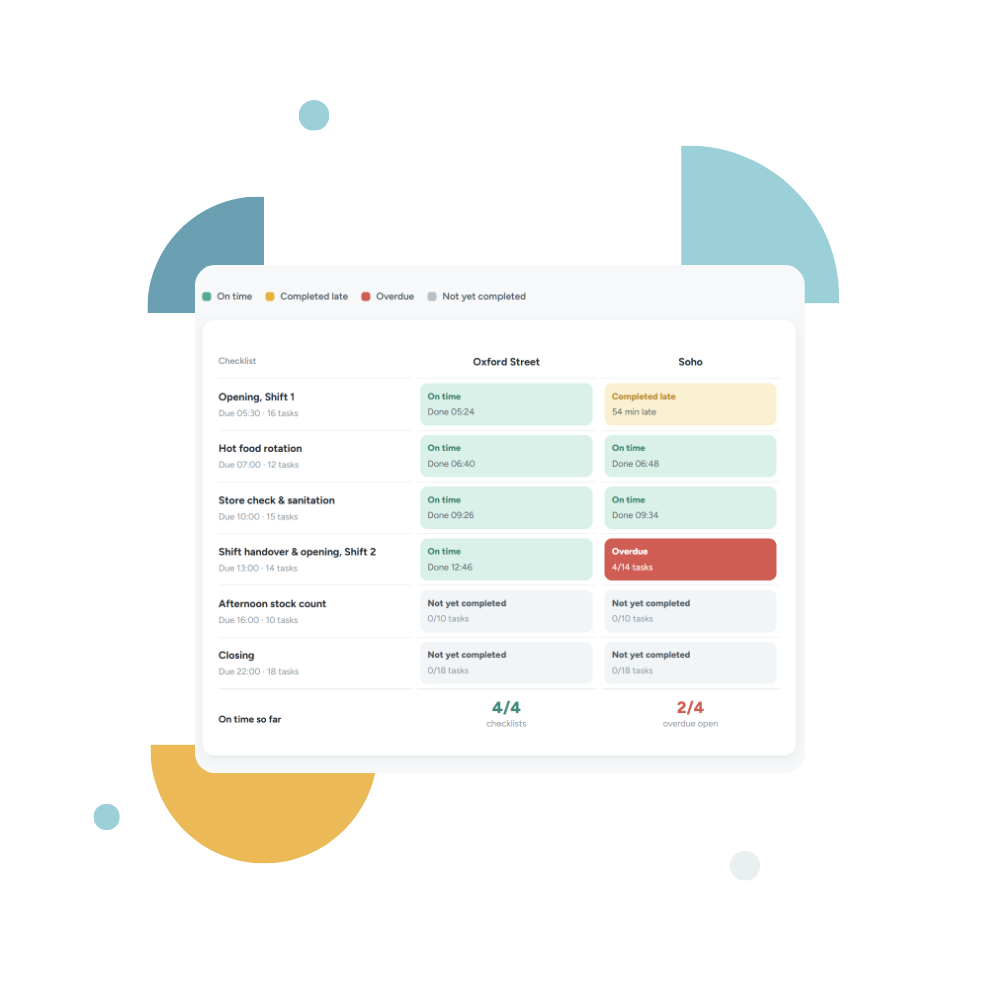
The opening routine appears when the shift starts, in order, on the phone or tablet the team already has. No binder, no WhatsApp, no relying on whoever opened yesterday to remember.
2. Through the shift
Tasks arrive when they’re needed, not all at nine
Schedule a check for the hour it matters. Due windows mean a task scheduled for the morning can’t be ticked at six in the evening.
3. In the moment
The ‘how to’ is attached to the task
Any task can carry the learning module or the communication that explains it. A new starter who’s never set up the promotion stand opens the task and finds the two-minute version. No guessing, no waiting for a manager, no leaving the floor.
4. Close and hand over
Nothing carries over unrecorded
Close-down checks are logged, attributed and time-stamped, so the next shift starts from what actually happened rather than what someone meant to mention.
Analytics
Know what’s slipping, store by store
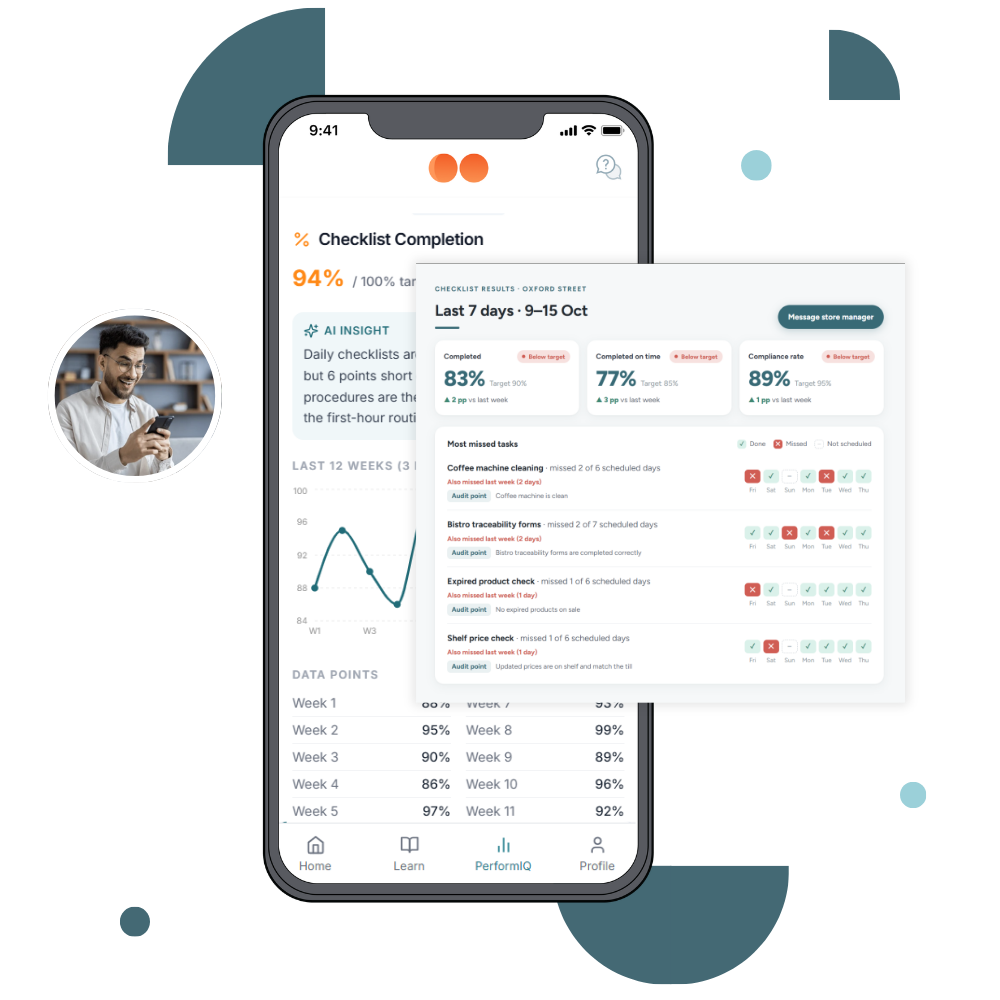
Completion, on-time and compliance rates for every location, against target and updated daily. Below them, the tasks actually being missed — which ones, on which days, and whether the same ones were missed the week before, so you can tell a one-off from a pattern.
Connected to your sales numbers
Checklist completion sits inside PerformIQ alongside your main unit performance indicators. When a number moves, the behaviours behind it are on the same screen, updated daily rather than at month end.

We’ll let customers do the talking for us
“In fifteen years of running stores, I’ve rarely seen the standard itself be the problem. Most businesses have manuals, training and checklists — the real challenge is making sure those standards happen consistently on the floor, every shift and every day.”
 Tomasz Bojko
Chief Operating Officer, Ana Pan
Ex Operations Manager, Pret a Manger UK
What you can do with Moonstar
A routine only sticks if the team knows why it matters and how to do it.
Frequently Asked Questions
Store operations is the day-to-day running of a retail location: opening and closing routines, stock and merchandising standards, cleanliness and safety, shift handovers, and the checks that keep each of those consistent. In a multi-site business it also covers making sure the same standards hold in every location, not only the ones head office visits most often.
A daily store opening checklist usually covers the checks that have to happen before customers arrive: equipment switched on and working, stock replenished and priced correctly, displays and promotions set up, cleanliness and safety, and the team briefed on the day’s priorities. The most useful ones are ordered in the sequence the shift actually runs, rather than grouped by department.
Operational excellence in retail means achieving the same standard in every location, every day — not only in the stores that happen to be well run. It’s measured less by how good the best store is and more by the gap between the best and the worst. Across a multi-unit company, consistency shows up in the numbers more reliably than peak performance does.
Store operations covers everything involved in running a location day to day. Retail execution is narrower: carrying out a specific set of head-office instructions — a promotion, a planogram, a campaign — correctly and on time in every store. Execution is part of operations. The two are often used interchangeably, but execution usually implies something being rolled out, where operations implies something being maintained.
Three things make daily routines stick: they appear at the moment they’re needed rather than as a list at the start of the shift, they’re short enough to complete on the floor — including capturing a photo or a note where one is needed — and someone sees whether they happened. In Moonstar, routines are scheduled with a start time and a due window, completed on mobile, and reported by store and by person — including whether the same check was missed the week before.
Grocery store operations carry more time-critical and compliance-bound routines than most retail: date and freshness checks, temperature logs, waste recording, counter and bake-off preparation, and allergen labelling. Many are legally required and subject to inspection, so the evidence matters as much as the task. That makes scheduling by hour, and photo evidence, more important in grocery than in a fashion or specialty store.
A new employee opens the task and finds the guidance attached to it — the learning module or the communication explaining how that step is done. They don’t need to search for a document, remember a session from their first week, or interrupt a manager mid-shift. The same applies to experienced staff on routines that happen rarely enough to be forgotten in between.